What Is a Psychodiagnostic Assessment? A Licensed Psychologist's Guide
If you've been told you might need a psychodiagnostic assessment, or you've searched for answers about your own mental health and keep running into unfamiliar clinical language, you're not alone. Many people reach out for this kind of testing after months, or even years, of feeling like something is "off," yet no one has been able to name it clearly. This guide breaks down what a psychodiagnostic evaluation actually involves, why it matters, and how it can bring genuine clarity to your mental health journey.
What Is a Psychodiagnostic Assessment?
A psychodiagnostic assessment is one type of psychological assessment — a structured process used by a licensed psychologist to understand how your mind works, identify patterns in your thoughts, emotions, and behavior, and determine whether a diagnosable condition is present. Unlike a single conversation with a therapist, this type of evaluation combines several sources of information: a detailed clinical interview, standardized and validated psychological tests, behavioral observation, and often input from people who know you well, such as a partner, parent, or teacher.
The purpose of this testing is not to label you, but to build an accurate, evidence-based picture of your psychological functioning so that any recommendations that follow are actually suited to you. This is especially important because many conditions share overlapping symptoms. Anxiety, ADHD, and autism spectrum traits, for example, can all show up as difficulty concentrating or feeling overwhelmed, yet each requires a different approach. A thorough psychodiagnostic evaluation helps separate these possibilities so you're not guessing at treatment.
What Happens During a Psychodiagnostic Evaluation?
Every psychodiagnostic evaluation is tailored to the person and the referral question, but most follow a similar structure:
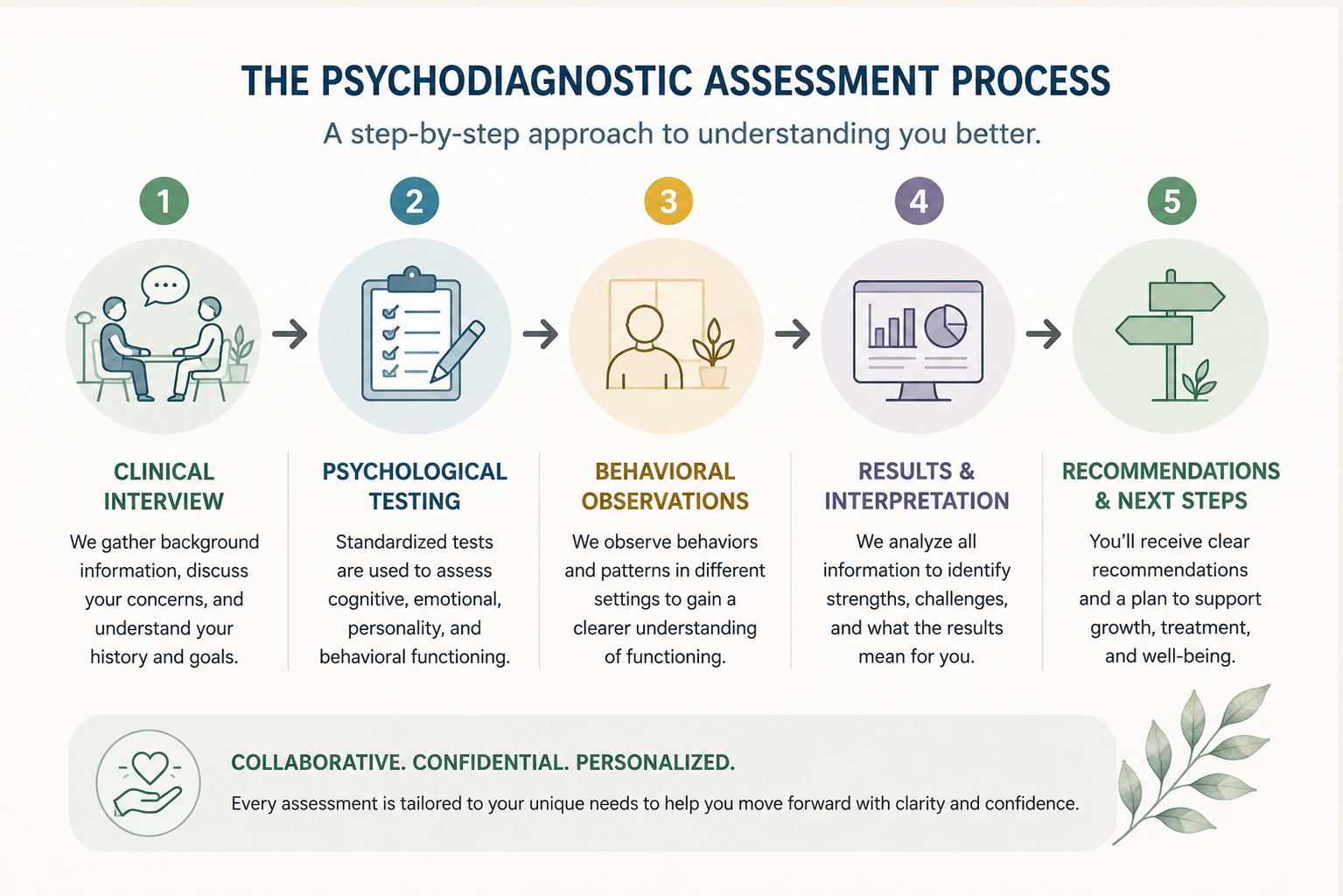
Initial consultation: A brief phone or video conversation to understand your concerns and confirm that this type of testing is the right fit.
Clinical interview: An in-depth conversation covering your developmental history, current symptoms, medical background, family history, and daily functioning.
Standardized testing: A combination of validated tools that measure attention, mood, personality, cognitive functioning, or autism-related traits, depending on what's being assessed.
Collateral information (when relevant): Questionnaires completed by a partner, parent, or close contact to provide additional perspective, particularly for ADHD or autism evaluations.
Scoring and interpretation: The psychologist analyzes the results against established norms to identify meaningful patterns.
Feedback session: A conversation where your psychologist walks you through the findings in plain language, answers your questions, and discusses next steps.
Written report: A comprehensive document summarizing the findings, the diagnosis (if applicable), and specific, individualized recommendations.
This process typically spans several sessions rather than a single appointment, because meaningful psychodiagnostic testing requires time to administer properly and interpret with care.
Why a Psychodiagnostic Assessment Matters
1. It leads to an accurate diagnosis. Symptoms alone rarely tell the whole story. Someone struggling to focus at work could be dealing with ADHD, generalized anxiety, depression, unprocessed trauma, or some combination of these. Objective, standardized testing — not guesswork — helps differentiate between conditions that can look similar on the surface but need very different treatment approaches.
2. It creates a genuinely individualized treatment plan. Once a psychodiagnostic evaluation is complete, your psychologist can recommend interventions matched specifically to your presentation: a certain type of therapy, medication consultation, workplace or academic accommodations, or a referral to another specialist. Treatment built on real data tends to work faster and more effectively than treatment built on assumptions.
3. It validates your experience. Many people carry years of self-doubt, wondering whether their struggles are "real" or whether they're simply not trying hard enough. Receiving clear, documented results can be enormously relieving. It replaces vague self-criticism with concrete understanding, which is often the first step toward meaningful change.
4. It supports accommodations and legal or academic needs. Formal testing is frequently required to request accommodations for standardized testing, university coursework, or workplace adjustments. Because these results are standardized and defensible, they carry weight with schools, licensing boards, and employers in a way that a brief consultation cannot.
5. It tracks change over time. For some individuals, this kind of testing isn't a one-time event. Re-testing after a period of treatment can show measurable progress, confirm that an intervention is working, or reveal that a treatment plan needs to be adjusted.
Who Should Consider a Psychodiagnostic Assessment?
You might benefit from this type of testing if you:
Have long-standing difficulty with focus, organization, or follow-through and wonder if ADHD is part of the picture
Notice patterns of social, sensory, or communication differences that suggest autism spectrum traits, particularly if you were never formally evaluated as a child
Have received multiple, conflicting diagnoses in the past and want clarity
Are applying for academic or workplace accommodations and need documentation
Are experiencing a complex mix of symptoms — mood, anxiety, trauma, attention — that a single conversation hasn't been able to untangle
Simply want a deeper, evidence-based understanding of how your mind works before starting or continuing therapy
As a licensed psychologist, I conduct this type of testing for adults navigating ADHD, autism spectrum disorder, and more complex psychological presentations. I work closely with each client to make sure the process feels collaborative rather than clinical and detached, because the goal is understanding, not just a diagnostic label.
How Long Does a Psychodiagnostic Assessment Take?
The timeline varies depending on the referral question and the number of tests involved. A focused assessment, such as one centered on ADHD, may take a few hours across one or two sessions. A more comprehensive psychodiagnostic assessment involving multiple domains — cognitive functioning, personality, mood, and autism-related traits — can take longer, sometimes spread across three or more appointments, followed by a feedback session and written report. Your psychologist should walk you through the expected timeline during your initial consultation so there are no surprises.
What Makes a Psychodiagnostic Evaluation Trustworthy?
Not all testing is created equal. A rigorous psychodiagnostic assessment relies on tools that are both reliable (producing consistent results) and valid (actually measuring what they claim to measure). It also requires a clinician trained to interpret results within the context of your full history, rather than reading test scores in isolation. Cultural background, language, and lived experience all shape how someone responds to standardized measures, so a thoughtful evaluation always considers the whole person, not just the numbers.
Taking the Next Step
Understanding what's really going on beneath your symptoms can be one of the most clarifying experiences of your mental health journey. A psychodiagnostic assessment replaces uncertainty with answers you can actually act on, whether that means starting a new treatment approach, requesting accommodations, or simply making sense of a lifetime of unanswered questions.
If you're considering a psychodiagnostic evaluation for yourself or a loved one, I invite you to reach out for a free 15-minute consultation. We'll talk through your concerns, determine whether testing is the right fit, and map out what the process would look like for you.
Frequently Asked Questions
Q1 What is the difference between a psychodiagnostic assessment and a psychological evaluation?
The terms are often used interchangeably. Both refer to a structured process combining clinical interviews and standardized testing to diagnose and understand a person's psychological functioning. "Psychodiagnostic" simply emphasizes the diagnostic focus of the evaluation.
Q2 How much does a psychodiagnostic assessment cost?
Cost varies based on the scope of testing, the number of sessions required, and the provider. Many practices offer a free initial consultation to outline expected costs before you commit to full testing.
Q3 Does insurance cover a psychodiagnostic evaluation?
Coverage depends on your specific plan and diagnosis codes. Some insurers reimburse a portion of testing costs, particularly when the evaluation is medically necessary. It's best to confirm coverage details during your consultation.
Q4 How soon will I get my results?
Most psychologists schedule a feedback session within one to three weeks after testing is complete, followed by a full written report summarizing the findings and recommendations.