How to Get Accommodations for High-Stakes Exams
Preparing for a high-stakes exam like the LSAT, MCAT, GRE, GMAT, or California Bar Exam can be stressful on its own. But if ADHD, a learning disability, or another disability affects the way you process information, sustain attention, read, or manage time, standard testing conditions may create an additional barrier.
You may understand the material and still struggle to demonstrate what you know within the standard testing format. Accommodations for high-stakes exams are designed to help address disability-related barriers so that testing conditions more accurately allow you to demonstrate your abilities.
If you're beginning to explore your options, you can learn more about high-stakes exam accommodations and the assessment process.
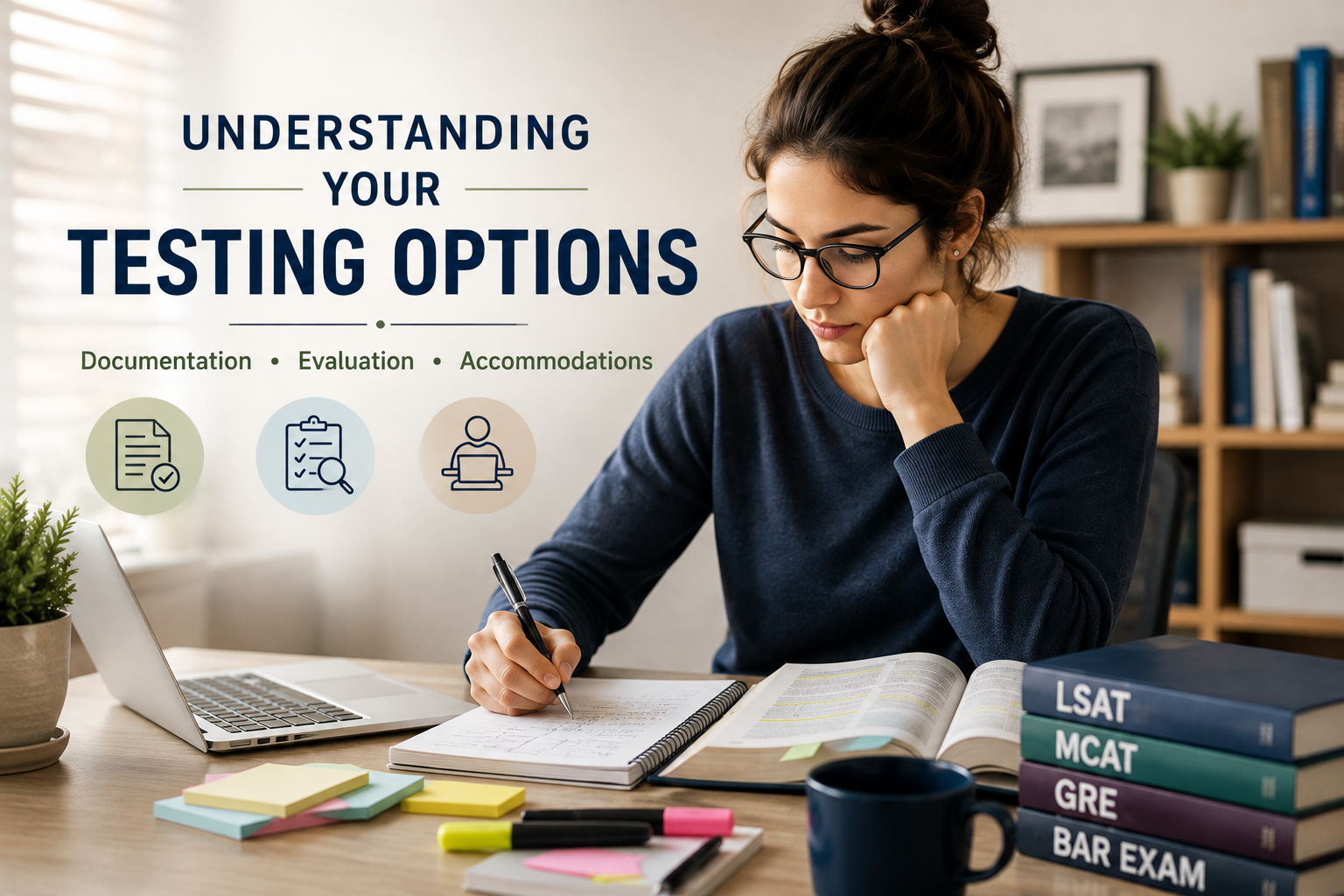
What Are Exam Accommodations?
Testing accommodations are adjustments to standard exam conditions intended to provide equitable access for individuals with documented disabilities.
Depending on the exam and an individual's documented needs, accommodations may include:
Extended testing time
Additional or extended breaks
A separate or reduced-distraction testing environment
Assistive technology
Other approved testing supports
Accommodations are not intended to make an exam easier or change what the exam measures. Instead, they are intended to reduce barriers associated with a disability so that the exam can more accurately reflect an individual's knowledge and abilities.
The accommodations available—and the documentation required to request them—vary by testing organization.
How to Get Testing Accommodations
The accommodations request process varies depending on the exam, but there are several common steps.
First, review the current accommodations policies and deadlines for the specific exam you plan to take. Testing organizations may have different application procedures and documentation requirements.
You may need to provide documentation of a qualifying disability, along with information about how that condition affects your ability to take the exam under standard testing conditions.
For some applicants, existing documentation may be sufficient. For others, updated or additional testing may be helpful.
The goal is not simply to establish that you have a diagnosis. Documentation may also need to explain how a condition affects relevant areas of functioning and why a particular accommodation is being requested.
When Is Psychoeducational Testing for Accommodations Helpful?
A comprehensive evaluation may be helpful when you need updated documentation, have never been formally evaluated, or need a clearer understanding of how a condition affects your functioning in academic or testing environments.
Depending on your individual concerns and the purpose of the evaluation, the assessment may include a clinical interview, a review of relevant history and records, and standardized testing.
A comprehensive assessment can help identify patterns of strengths and difficulties in areas such as attention, memory, processing speed, executive functioning, reading, or other relevant skills.
You can learn more about psychodiagnostic testing and what a comprehensive psychological assessment may involve.
Exam Accommodations for ADHD
ADHD can affect test-taking in different ways. Some people experience difficulty sustaining attention during lengthy exams, managing time, processing information efficiently, or maintaining focus in distracting environments.
Having ADHD does not automatically mean that someone will qualify for accommodations. Testing organizations generally consider the individual's documentation, functional limitations, and their own eligibility criteria.
If you have never been formally evaluated—or if your previous assessment no longer reflects your current needs—an ADHD evaluation may help clarify whether ADHD is contributing to the difficulties you're experiencing.
A comprehensive evaluation can also help distinguish ADHD from other factors that may affect concentration or academic performance.
Exam Accommodations for Learning Disabilities
Learning disabilities can affect skills that are particularly important during standardized testing, including reading, writing, processing information, and other academic tasks.
For someone with a documented learning disability, standard testing conditions may create barriers that are not directly related to their understanding of the material.
A comprehensive evaluation can help identify relevant patterns of strengths and challenges and document the ways a learning disability may affect functioning.
The type of evaluation and documentation required depends on the individual and the specific testing organization.
If you are exploring assessment options more broadly, you can visit the assessment services page to learn more about the types of evaluations offered.
What Does the Evaluation Process Look Like?
If you are considering an evaluation as part of an accommodations request, the process generally involves several stages.
1. Background Interview
The process typically begins with a discussion of your concerns and history.
You may talk about:
Your academic and educational experiences
Previous testing difficulties
Any past diagnoses
Previous accommodations, such as an IEP or 504 Plan
Your current work or academic demands
The challenges you experience while preparing for or taking exams
This information helps determine what questions the evaluation should address.
2. Comprehensive Testing
Depending on your concerns, you may complete standardized assessments that examine areas such as:
Attention
Memory
Processing speed
Executive functioning
Reading
Writing
Other cognitive or academic skills
Testing may take place over one or more appointments. The amount of testing needed depends on the complexity and purpose of the evaluation.
3. Review and Interpretation of Results
After the assessment is complete, the evaluator reviews and interprets the results in the context of your history and current concerns.
The findings may help identify patterns of strengths and difficulties, clarify whether a diagnosis is appropriate, and provide recommendations based on the results.
4. Written Documentation and Feedback
You will typically receive feedback about the results and have an opportunity to discuss any recommendations.
Depending on the purpose and scope of the evaluation, a written report may document relevant findings and functional limitations that can be considered as part of an accommodations request.
It is important to remember that the testing organization—not the evaluator—makes the final decision about whether accommodations are approved.
What If You've Never Been Diagnosed Before?
You do not necessarily need to have received a diagnosis during childhood to explore whether an evaluation may be appropriate.
Some people develop effective strategies that help them manage attention, learning, or processing difficulties throughout school and work. These challenges may become more noticeable when the demands increase, particularly during lengthy and highly competitive exams.
If you have consistently felt that you understand the material but struggle to demonstrate your knowledge under timed testing conditions, an evaluation may help clarify what is contributing to those difficulties.
A formal evaluation does not guarantee that an accommodations request will be approved. Each testing organization has its own criteria and reviews requests according to its current policies.
What Happens If Your Accommodations Request Is Denied?
Receiving a denial can be frustrating, but it may not always be the end of the process.
The appropriate next step depends on the reason for the decision and the policies of the specific testing organization.
In some cases, additional or updated documentation may be helpful. In others, the issue may involve the information provided or the connection between the documented disability and the accommodation requested.
If your request is denied, carefully review the decision and the current policies for the exam before deciding how to move forward.
How to Prepare for the Accommodations Request Process
If you think you may need accommodations for an upcoming exam, starting early can make the process less stressful.
Consider the following steps:
Review the exam's current policies. Requirements and deadlines vary by organization.
Gather previous documentation. This may include prior evaluations, school records, or documentation of previous accommodations.
Consider whether updated testing may be helpful. A qualified evaluator can help determine whether a comprehensive assessment is appropriate.
Allow enough time. Evaluations, report preparation, application deadlines, and review periods can all take time.
Understand that approval is not guaranteed. The testing organization makes the final decision according to its own criteria.
Getting Started
If ADHD, a learning disability, or another disability may be affecting your performance on an important exam, it can be helpful to explore your options before your test date gets too close.
A comprehensive evaluation may help you better understand the difficulties you're experiencing and determine what documentation may be relevant to an accommodations request.
To learn more about evaluations for professional and academic testing, visit the high-stakes exam accommodations page.
If you're unsure whether an evaluation may be appropriate for your situation, you can contact Dr. Lindsay Mayott to schedule a free 15-minute consultation.
High-stakes exams are challenging enough. Understanding your needs and options can help you approach the process with greater clarity and preparation.
Frequently Asked Questions
Do I need a diagnosis to request accommodations for a high-stakes exam?
Requirements vary depending on the exam and testing organization. In many cases, documentation of a qualifying disability is required. The documentation requirements may also address how the condition affects your ability to take the exam under standard testing conditions.
Review the current policies for your specific exam to understand what documentation is required.
How long does the accommodations process take?
The timeline varies. It may include gathering documentation, completing an evaluation if needed, preparing a report, submitting your request, and waiting for the testing organization to review it.
Starting well before your planned exam date can give you more time to understand the requirements and complete any necessary steps.
Can I get exam accommodations for ADHD?
Possibly. Having an ADHD diagnosis does not automatically guarantee approval. Testing organizations typically have their own eligibility criteria and documentation requirements.
A comprehensive evaluation may help clarify how ADHD affects relevant areas of functioning and whether additional documentation is appropriate.
What if I have never been tested for a learning disability?
You can still explore whether an evaluation is appropriate. A comprehensive assessment may help identify learning-related difficulties and provide a clearer understanding of your cognitive and academic functioning.
The specific documentation needed for an accommodations request depends on the exam and testing organization.
Does a psychological evaluation guarantee that my accommodations will be approved?
No. An evaluation may provide information and documentation that can be relevant to an accommodations request, but the testing organization makes the final decision about approval.
It is important to review the current requirements for your specific exam and understand that eligibility decisions are made according to the organization's policies.