ADHD and Anxiety: Why They So Often Show Up Together
If you live with both ADHD and anxiety, you've probably wondered which one is actually running the show. Is your racing heart before a deadline anxiety, or is it the pressure of ADHD-related procrastination finally catching up with you? Is your mind jumping between five different worries because of generalized anxiety, or because your ADHD brain never really slows down? I hear some version of this question a lot in my office, and it's a fair one to ask. ADHD and anxiety overlap so often, and so convincingly, that plenty of people live for years without realizing they're dealing with both at once.
So let's untangle it a bit: how common this really is, why the two conditions end up so tangled together, how to tell their symptoms apart, and what treatment looks like when it's actually built for both.
How Common Is It to Have ADHD and Anxiety Together?
Pretty common, as it turns out. Research suggests close to half of adults with ADHD also meet criteria for a diagnosable anxiety disorder, well above the rate in the general population, and it shows up especially in adults who weren't identified with ADHD as kids. Years of struggling with focus and follow-through without an explanation for it will wear on almost anyone, and for a lot of people, that wear-and-tear eventually becomes an anxiety disorder in its own right.
None of this is a coincidence, and understanding why it happens is what makes treating both conditions possible.
Why ADHD and Anxiety Show Up Together
A few things are usually at play here, and they tend to overlap rather than act alone.
The most obvious is plain wear and tear. Forgetting appointments, losing track of time, misplacing your keys for the third time this week, missing a deadline you swore you'd hit this time — all of it creates a steady undercurrent of worry. Give that enough time, and the low-grade "wait, did I forget something?" feeling can harden into a genuine anxiety disorder, even in someone who was never especially anxious to begin with.
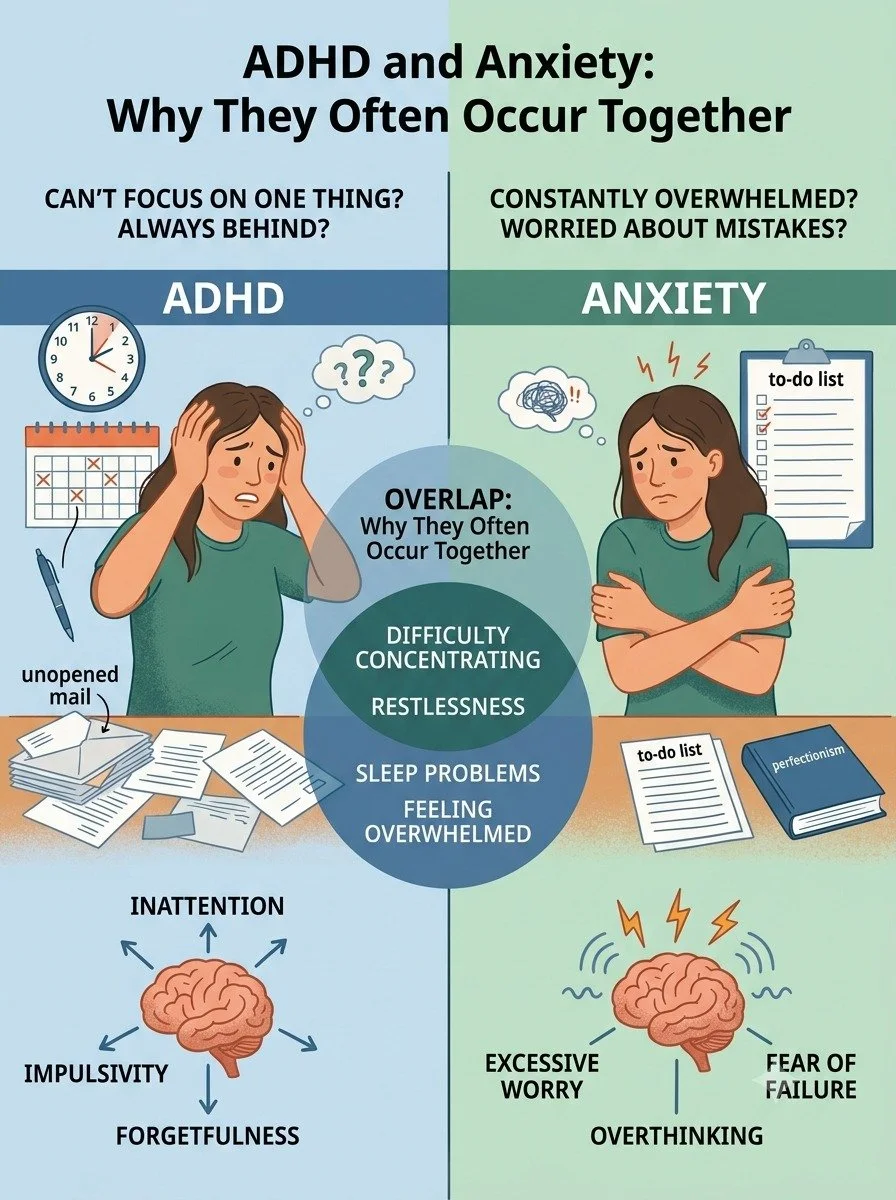
There's also a biological piece. Both conditions involve differences in how the brain regulates attention, emotion, and its response to perceived threat, and some of the genetic and neurological vulnerabilities behind them seem to overlap, which is part of why they so often run in the same families, and the same person.
Then there's masking. Many adults, women especially, learn to cover their ADHD by over-preparing, triple-checking everything, and staying on high alert so nothing slips through the cracks. It works, sort of, but it's exhausting, and the sheer effort of holding it all together can become its own source of chronic anxiety. If time pressure is a big piece of your pattern, ADHD time management strategies built around how your brain actually works can take some of that daily strain off.
And finally, misdiagnosis. Anxiety can be loud enough to drown out the ADHD underneath it, so a clinician treats the worry and never gets to the attention piece. It happens the other way too, with ADHD named while a co-occurring anxiety disorder goes unaddressed. Either way, only half the picture gets treated, which is usually why relief doesn't stick.
ADHD or Anxiety? How to Tell the Symptoms Apart
ADHD and anxiety share so many surface-level symptoms, trouble concentrating, restlessness, irritability, disrupted sleep, that it can be hard to know which one is driving at a given moment. I often ask clients a simple question: which one is "driving the bus" right now?
Take concentration. With ADHD, attention is inconsistent no matter what's at stake; you can lose focus on things you genuinely care about. With anxiety, concentration tends to break down when worry spikes, and it comes back once you feel calm again. Restlessness works the same way: ADHD restlessness is more of a constant hum, physical or mental, that's just always somewhat present, while anxious restlessness is tied to one specific worry and eases once that worry resolves.
Even procrastination looks different depending on the source. In ADHD, it's typically a task-initiation problem, starting feels hard even when you want to begin, while anxious procrastination is more about avoiding the chance of doing something wrong.
These lines are blurry enough that self-diagnosis rarely gets you a clear answer. A trained clinician looks at the whole pattern, your history, and the context around each symptom, rather than any one clue in isolation.
Signs You Might Be Dealing With Both
Many people with co-occurring ADHD and anxiety recognize themselves in a few of these patterns:
You feel anxious specifically about the downstream effects of ADHD, like forgetting details, being late, or missing something important
Your anxiety hasn't meaningfully improved even after addressing life stress or practicing anxiety coping skills
You were treated for anxiety, but your organization, focus, and follow-through never got better
Small, unremarkable tasks trigger dread out of proportion to the task itself, because deep down you're not confident you'll actually follow through
Your mind feels "too full" with worry and unable to settle on any one thing, both at the same time
If several of these sound familiar, it's worth exploring whether one diagnosis has been hiding the other.
Why an Accurate Diagnosis Matters
When only one condition gets treated, progress tends to stall in frustrating ways. Anxiety treatment alone might ease general worry but leave someone still missing deadlines and losing things, which just generates new anxiety. ADHD treatment alone might sharpen focus but leave an underlying anxiety disorder untouched. A comprehensive evaluation sorts out which symptoms belong to which condition, and how they interact in your specific case. If you suspect ADHD hasn't been fully assessed, ADHD testing can clarify the picture; this guide on how to get tested for ADHD as an adult walks through what that process involves.
Treating ADHD and Anxiety Together
Both conditions respond well to treatment, and outcomes are noticeably better when someone addresses both instead of just one. Cognitive Behavioral Therapy works well for anxiety on its own, and it can also be adapted to tackle the executive function and self-esteem struggles that come with ADHD. For a lot of clients, learning to tell an anxious thought apart from an ADHD-driven one, in real time, ends up being one of the most relieving parts of the work. It's hard to keep blaming yourself once you can actually name what's happening.
Effective care usually includes:
A thorough assessment to clarify what's ADHD, what's anxiety, and what's both
Therapy that targets anxious thinking while also building systems for attention and organization
Coordination with a prescriber if medication fits into the plan
Ongoing support as symptoms shift, since improving one condition often changes how the other shows up
A therapist for ADHD or anxiety can help with either on its own, but when both are present, treatment built around the relationship between them tends to produce more lasting relief than treating either in isolation.
Getting Support for ADHD and Anxiety
Living with both ADHD and anxiety can feel like being pulled in two directions at once, but you don't have to untangle it alone. An accurate diagnosis and a treatment plan built around your specific pattern can make a real difference. If this sounds like you, reach out to schedule a free consultation to talk about testing or therapy options, whether you're local to Marin County or joining virtually from anywhere in California.
Frequently Asked Questions
Can ADHD cause anxiety?
ADHD doesn't directly cause anxiety, but the daily challenges it creates, like forgetfulness, missed deadlines, and disorganization, can generate chronic stress that develops into a genuine anxiety disorder over time.
Is anxiety a symptom of ADHD?
Anxiety isn't an official symptom of ADHD, but the two conditions overlap so often that many people experience them as intertwined. A careful evaluation can determine whether anxiety is a separate diagnosis or a byproduct of unmanaged ADHD.
Can you have both ADHD and an anxiety disorder at the same time?
Yes. Having both is common, and research indicates that a substantial portion of adults with ADHD also meet criteria for an anxiety disorder. Treating both conditions together typically leads to better outcomes than treating just one.
Does treating ADHD help reduce anxiety?
For many people, yes. When ADHD symptoms like disorganization and forgetfulness improve, the chronic worry tied to those struggles often eases as well, although a separate anxiety disorder may still need its own targeted treatment.